There’s a belief that shows up again and again in cycling discussions: more spokes equals a stronger wheel.
On the surface, it makes sense. More support points should spread the load, reduce stress, and improve durability. But once you look at how a rim actually carries force in real riding conditions, the story becomes less straightforward.
Wheel strength is not just about adding spokes. It’s about what the rim is forced to become every time you add another hole.
🔧 A rim is a continuous structure first, a drilled part second
A rim is often imagined as a rigid circle that spokes simply “hang from.” In reality, it behaves more like a continuous tension ring, where strength comes from the uninterrupted flow of hoop stress around the circumference.
That continuity matters.
Every spoke hole interrupts that flow.
Each drilling point introduces a small discontinuity in the structure. Under load—cornering, impacts, hard acceleration—the stress no longer travels smoothly. It has to divert around each opening. One or two holes don’t change much. But as the count increases, the rim gradually shifts from a continuous ring into a segmented structure with more and more stress interruptions.
The result isn’t immediate failure. It’s a slow reduction in structural margin.
⚠️ The real weak point: the bridge between holes
If you strip a rim down to what actually fails over time, it’s rarely the spoke hole itself. It’s the material between holes.
That area—the bridge—is what keeps the rim behaving like a ring instead of a perforated strip.
As spoke count increases, those bridges shrink. Less material means less ability to resist cracking, deformation, and long-term fatigue. Even if the spoke support increases, the rim itself is quietly losing structural continuity.
This is why spoke count alone can be misleading. Two rims with identical weight can behave very differently simply because one preserves more material in the bridge zone.
⚡ Fewer spokes, higher efficiency—if the system is balanced
When spoke count drops, each spoke carries more load. That allows higher spoke tension and a more direct load path from hub to rim.
Done correctly, this can improve stiffness and responsiveness. The wheel feels more connected, more immediate. Not because it is “less built,” but because the structure is working more efficiently.
But this only holds when every part of the system is designed for it. Rim strength, spoke quality, and hub stability all have to scale together. If one part is underbuilt, the advantage disappears quickly.
🛠️ What actually matters when choosing a wheel
At a practical level, most riders overestimate spoke count and underestimate everything around it.
Rim design—especially bridge thickness and spoke hole reinforcement—plays a bigger role in long-term durability than the raw number of spokes.
Spoke tension balance matters just as much. A well-tensioned 24-spoke wheel can outperform a poorly built 32-spoke wheel in stiffness, durability, and ride feel.
And then there’s the system itself. Because once spoke count goes down and tension goes up, the wheel stops being a collection of parts and starts behaving like a unified structure.
🎯 The part people often miss: the hub decides the ceiling
At that point, the limiting factor quietly shifts.
Not the rim.
Not the spokes.
But the hub.
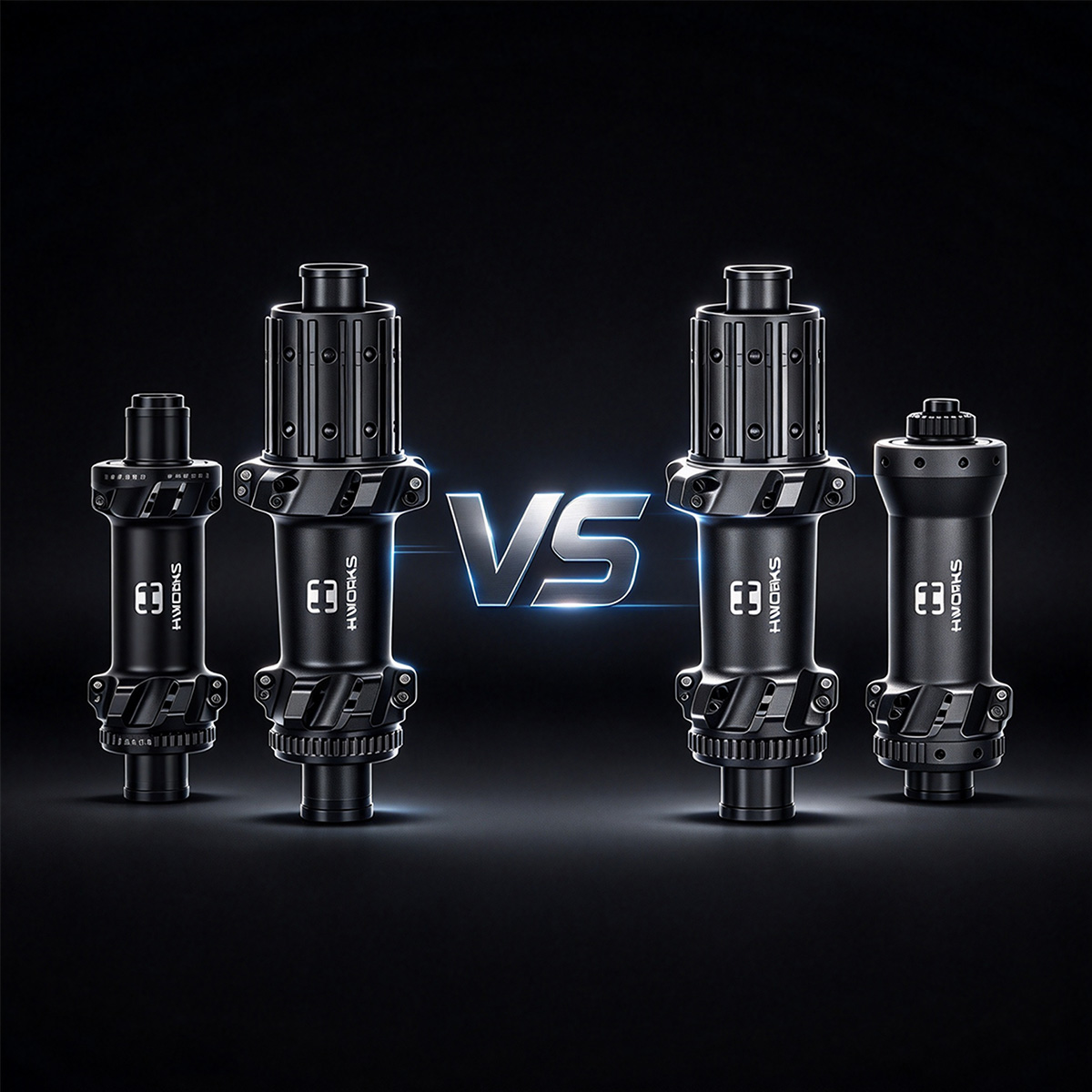
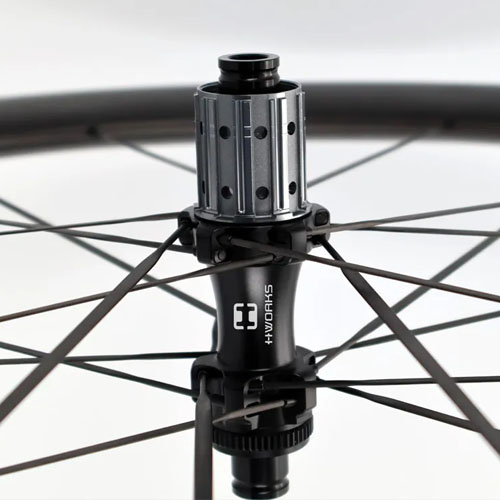
All spoke loads converge at the hub flange. That means flange geometry, material stiffness, machining precision, and bearing stability directly influence how evenly those forces are transmitted into the wheel.
A strong rim can only perform well if the hub delivers load cleanly and consistently. Any flex, misalignment, or uneven tension distribution at the hub gets amplified as spoke count drops and individual spoke load increases.
This is why experienced wheel builders rarely start from spoke count alone. They start from the center—because the hub ultimately defines how far the entire wheel system can be pushed.