Understanding the hidden core of your bicycle's drivetrain.
Encountering incompatibility between freehub body and cassette when upgrading your cassette? Unsure about the matching requirements of different freehub bodies when purchasing wheelsets? Many cyclists from entry-level to intermediate riders are often puzzled by the freehub body, the "hidden core component".
As the key transmission hub connecting the cassette and hub, the type and specification of the freehub body directly determine the compatibility of the drivetrain and power transmission efficiency, and further affect the riding feel and safety. This article provides a professional analysis of the characteristics and compatibility scope of mainstream hub freehub bodies, corrects common purchasing misconceptions, and offers practical suggestions combined with riding scenarios, helping cyclists with different needs choose the right freehub body for precise power delivery in every pedal stroke.
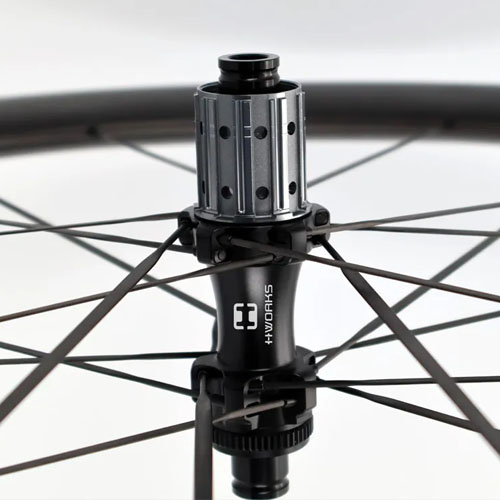
To select the correct freehub body, you must first clarify its core positioning and working principle. The hub freehub body is an independent component mounted on the right side of the hub, essentially a transmission carrier with a one-way ratchet & pawl mechanism. The cassette is fixed to the freehub body via splines or threads, performing the core functions of power transmission and one-way locking:
"If the bicycle drivetrain is compared to a 'power transmission belt', the hub freehub body is the 'transfer hub' of the belt: the cassette is the power 'receiving end', the hub is the power 'output end', and the freehub body is the critical node connecting them."
Its precision, strength and compatibility directly determine the smoothness and loss rate of power transmission. A high-quality freehub body ensures seamless, lag-free power delivery, while an ill-matched or low-quality one may cause abnormal noise, chain skip, power loss and other issues, severely impairing the riding experience and even posing safety hazards.
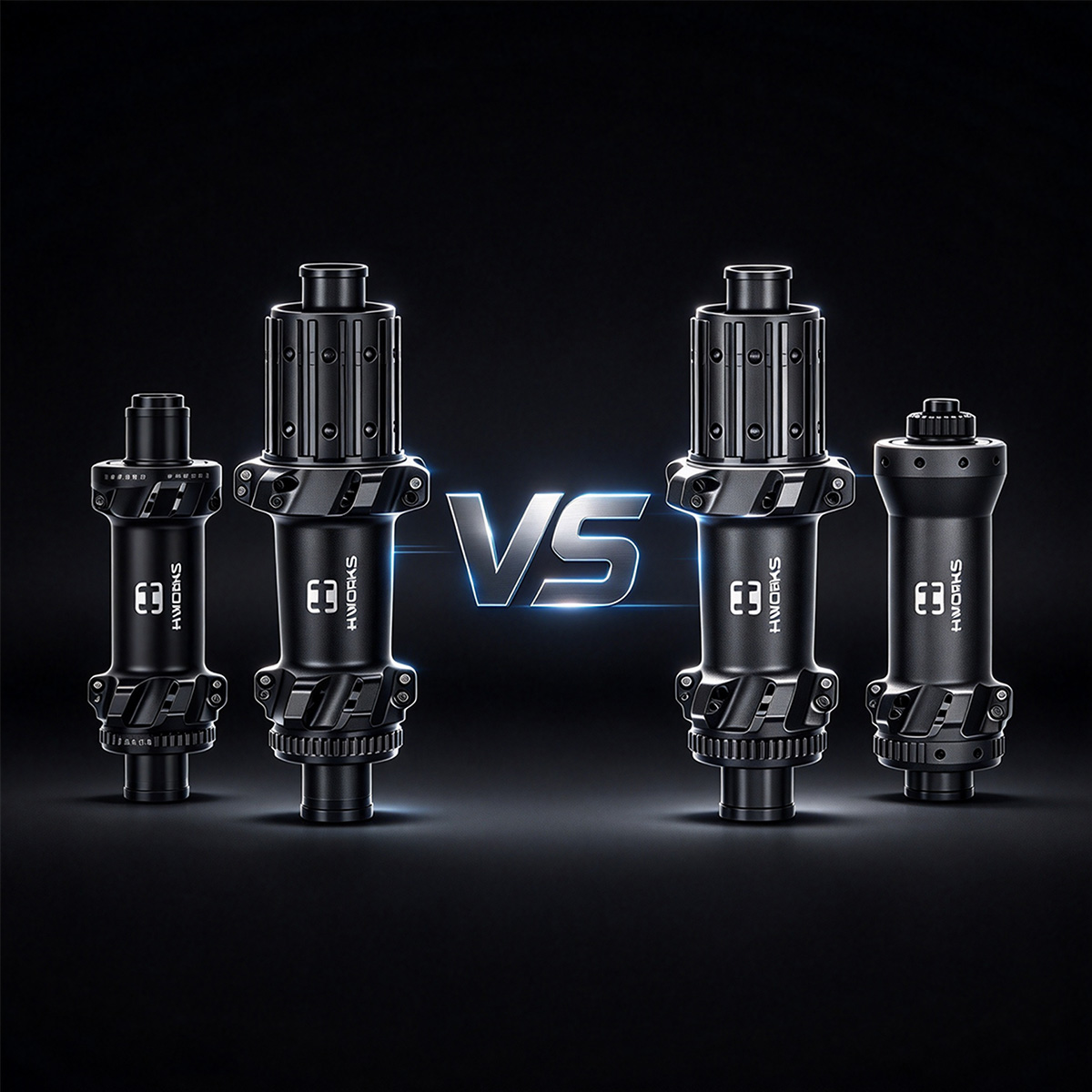
At present, all mainstream hub freehub bodies in the industry adopt a cartridge-style structure. According to different spline specifications and design standards, they are divided into four categories with distinct characteristics and compatibility scopes.

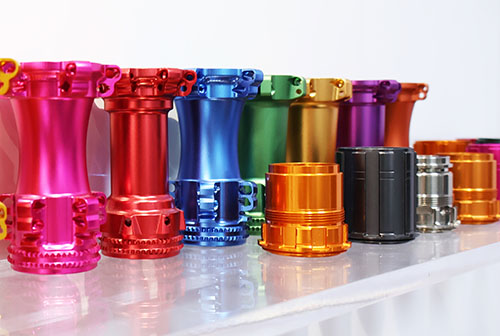
Visual comparison of common freehub body spline designs.
This is the most widely used freehub body type, featuring a 9-spline design with one slightly narrower spline for quick cassette alignment. Its core advantages are strong universality and high cost-efficiency.
| Feature | Specification |
|---|---|
| Spline Outer Diameter | 34.5mm |
| Speed Support | 8–12 speed drivetrains |
| Cassette Range | Minimum 11T, Maximum 46T |
| Best For | Entry & intermediate road/mountain bikes |
Note: When matching an 11-speed mountain bike cassette with a road HG freehub body, a 1.85mm spacer MUST be installed to prevent locking failure and abnormal noise.
Designed exclusively for 12-speed drivetrains, this high-precision freehub body (Micro Spline) adopts a 23-spline precision drive structure, with spline density 30% higher than HG type.
Divided into XD (MTB) and XDR (Road), these adopt a circlip-free structure and helical spline design. They are the mainstream configuration for high-end competition bikes.
Adopting a closed design standard, these are exclusively designed for high-end custom bikes and professional races, representing the benchmark for craftsmanship.
The core of choosing the right freehub body is precise matching across three dimensions: bike model, drivetrain speed, and riding scenario.
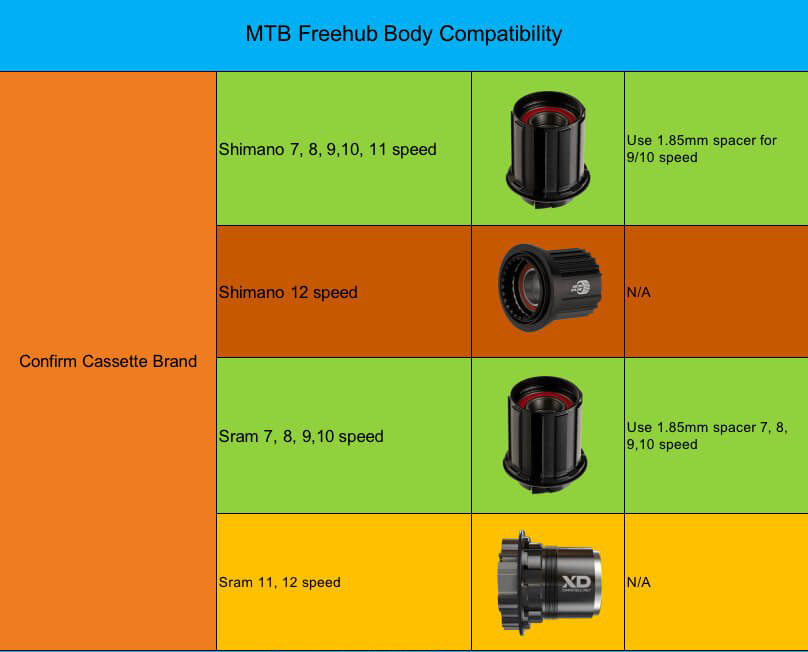
Quick reference chart for MTB freehub body compatibility.
Road bikes and MTBs have significantly different freehub body designs. Industry data shows that incorrect mixing increases power transmission loss by 15%–20% and raises the risk of chain skip.
| Speed | Compatible Types |
|---|---|
| 8–10 Speed | HG Type only |
| 11 Speed | Road: HG/XDR; MTB: HG |
| 12 Speed | Road: HG (partial)/XDR; MTB: MS/XD |
| 13 Speed | Premium Exclusive (CP/N3W) |
Prioritize HG type, follow spacer rules, and ensure regular maintenance.
Aluminum road bikes → HG; Carbon road bikes → XDR; MTB/Gravel → MS.
Final Reminder: Compatibility is the core. Ensure full matching with bike model, drivetrain and cassette. Regular maintenance extends service life.